Balast i Ocieplenie liczy balast i dobiera ocieplenie z fizyki — dla Ciebie, Twojego sprzętu i konkretnej wody — a po każdym nurkowaniu uczy się z Twojej oceny. Planer nurkowania liczy dekompresję, gaz, tlen i plany awaryjne na modelu Bühlmann ZHL-16C z gradient factors.
Ballast & Thermal works out your lead and exposure protection from physics — for you, your gear and the actual water — and learns from your rating after every dive. Dive Planner computes decompression, gas, oxygen and contingency plans with the Bühlmann ZHL-16C model and gradient factors.
GratisFreedla nurków — bez konta, bez reklam, bez subskrypcjifor divers — no account, no ads, no subscription
Aplikacja 1App 1Balast i OcieplenieBallast & Thermal
Doświadczony nurek zna swoją liczbę. Świeży — nie może jej znać: nowa pianka, pierwsza własna kamizelka, inna butla, morze zamiast jeziora i wszystko liczy się od nowa. Aplikacja daje punkt startowy z fizyki i przelicza go przy każdej zmianie.
An experienced diver knows their number. A new one can't: a new wetsuit, a first BCD of their own, a different cylinder, the sea instead of a lake — and everything starts over. The app gives a starting point from physics and recalculates it with every change.
kg
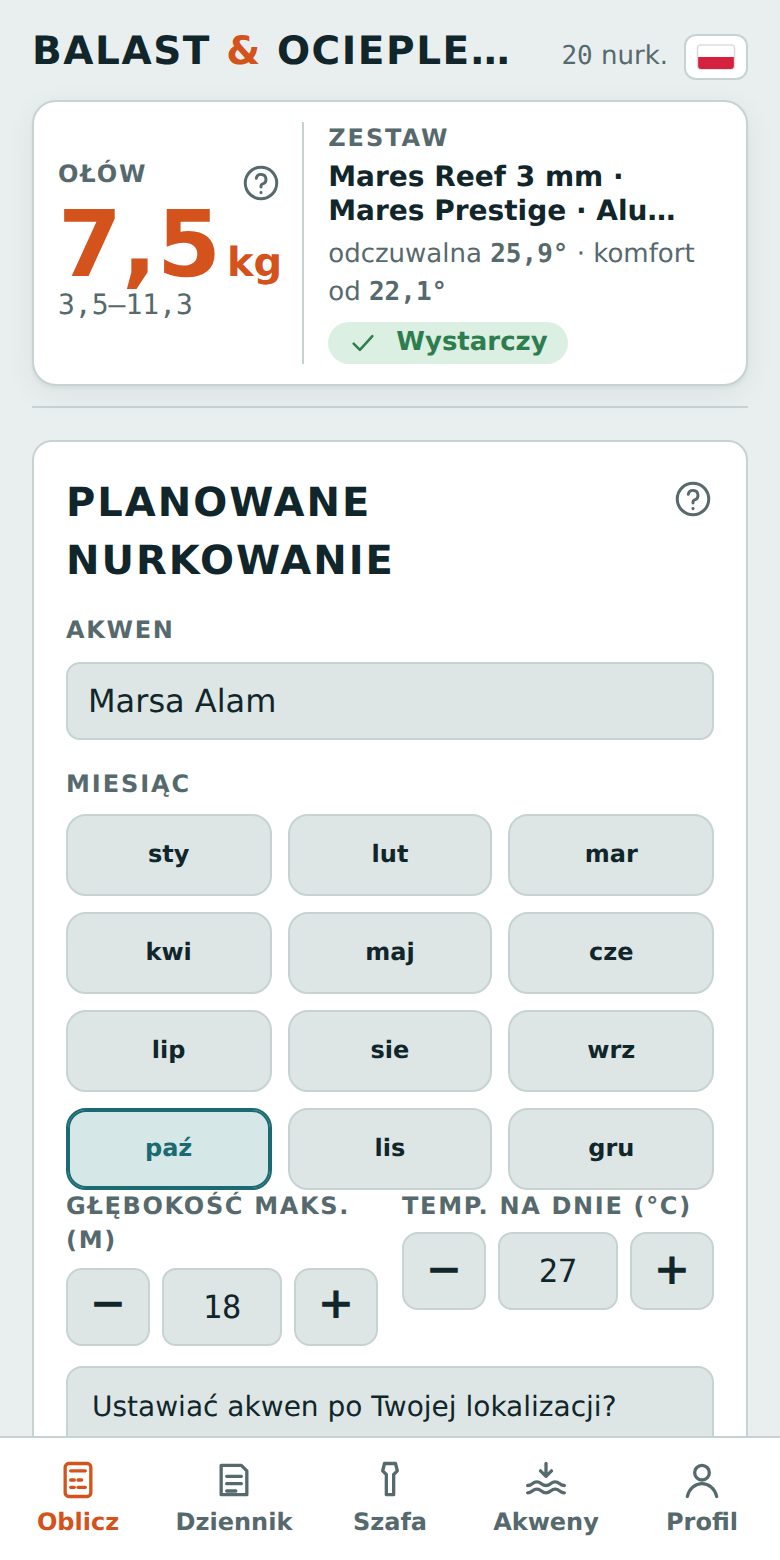
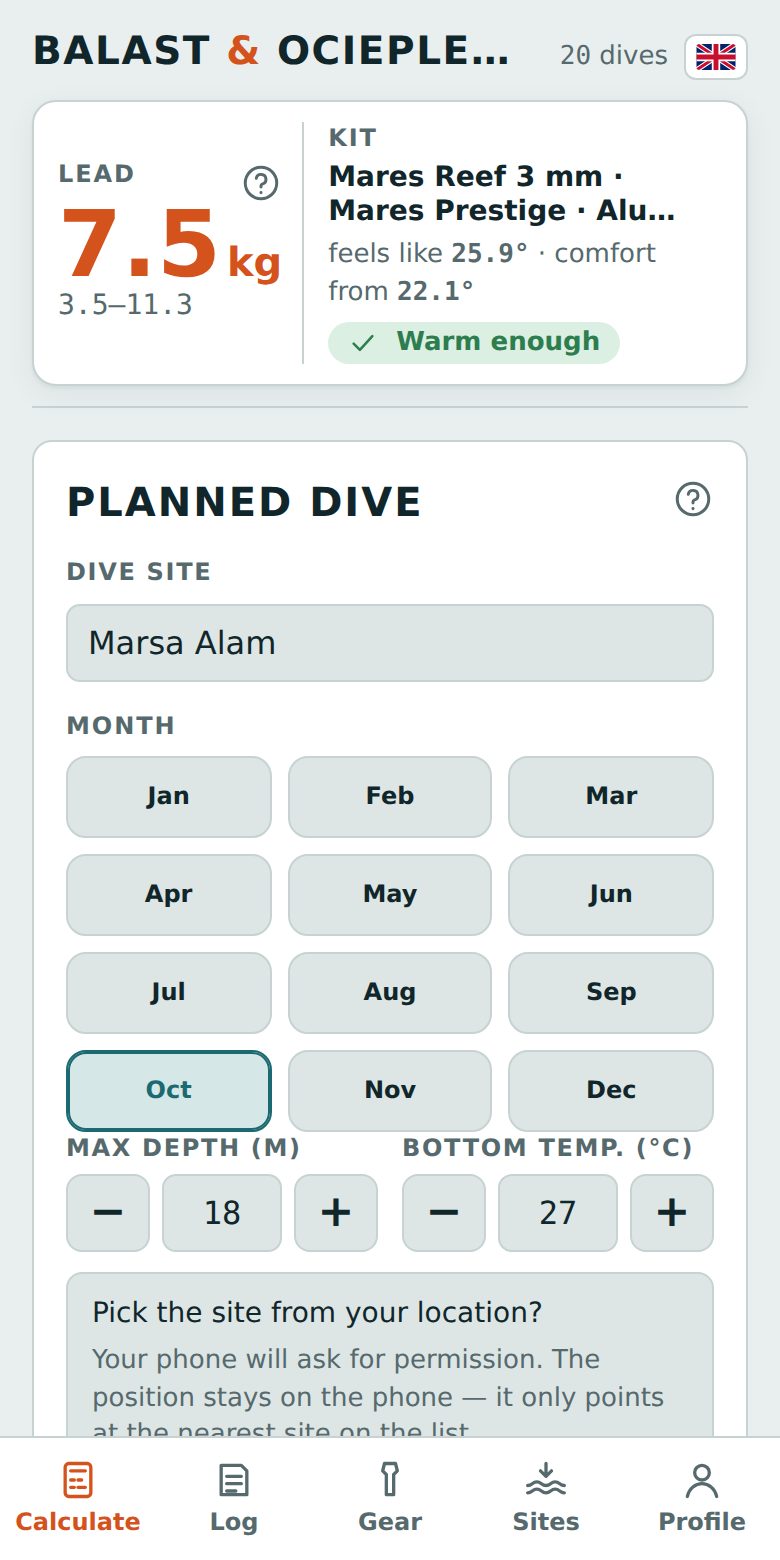
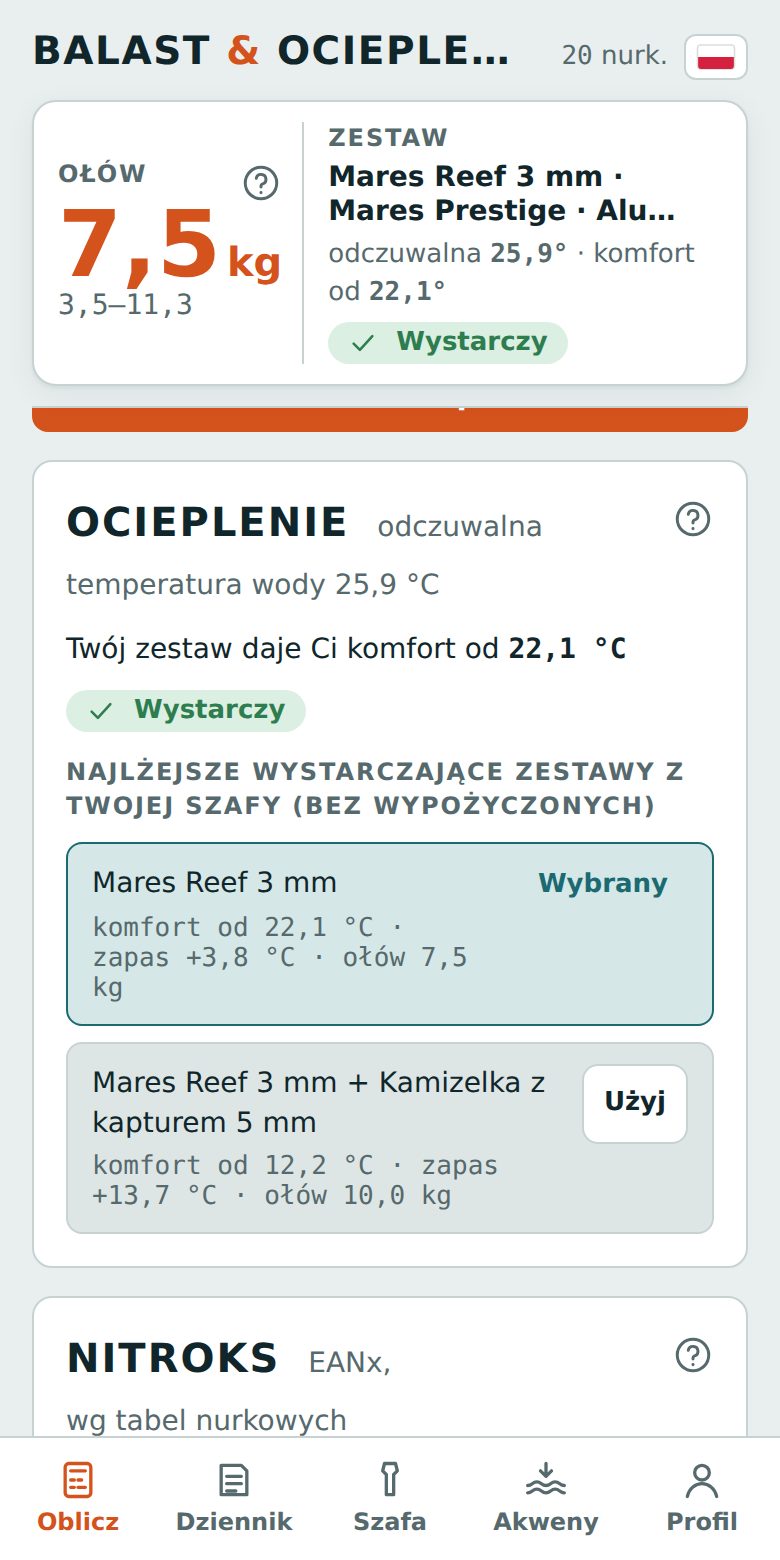
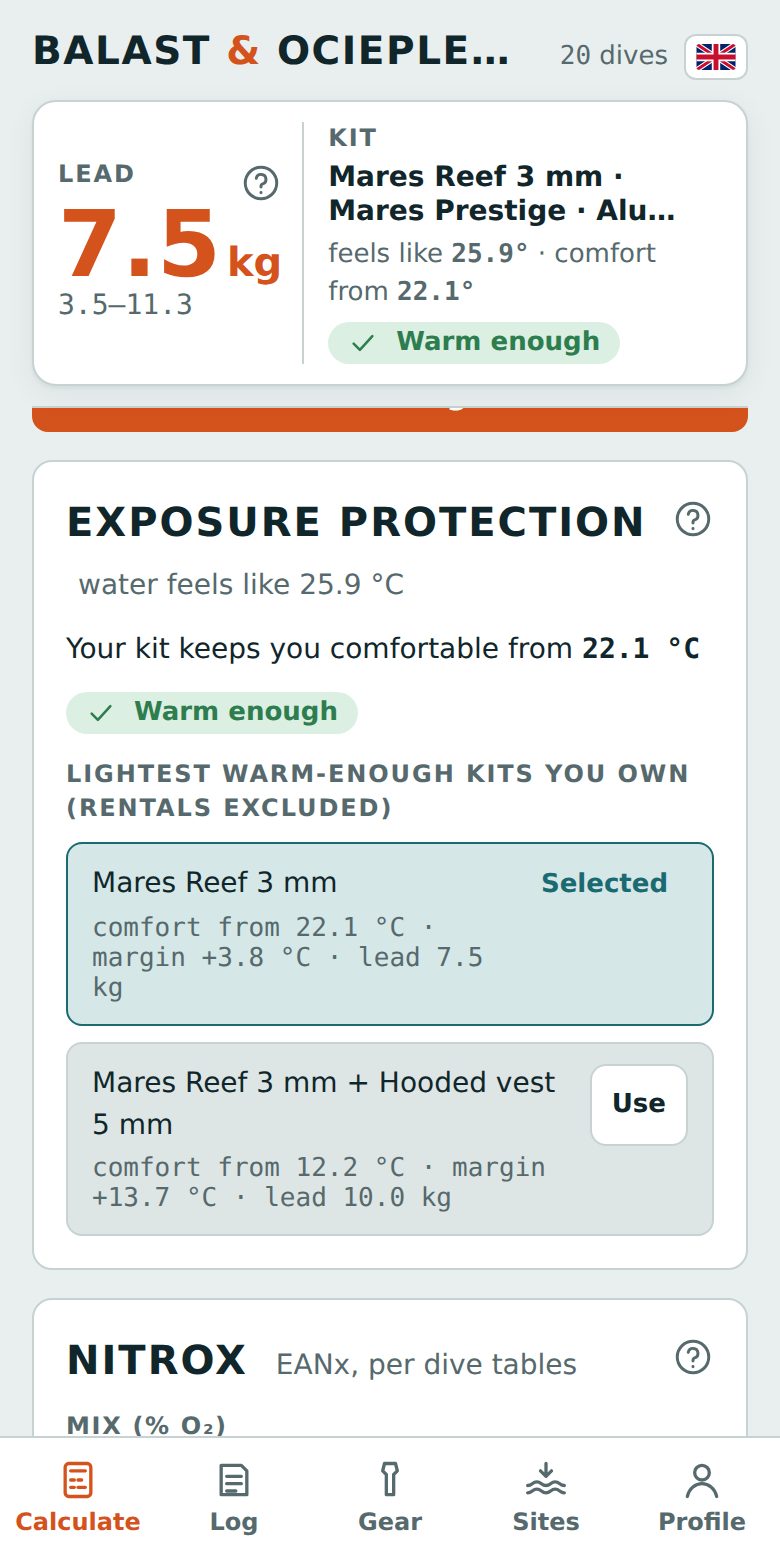
Ołów na punkcie kontrolnymLead at the check pointBilans wyporności na 5 m, z rezerwą w butli i pustą kamizelką — ciało, neopren ściskany głębokością, suchy skafander, butla, kamizelka, płetwy. W górę do 0,5 kg, z przedziałem 80%.A buoyancy balance at 5 m with a reserve in the cylinder and an empty BCD — body, neoprene compressed by depth, drysuit, cylinder, BCD, fins. Rounded up to 0.5 kg, with an 80% range.
°C
Czy nie zmarznieszWill you get coldPorównuje odczuwalną temperaturę wody z komfortem zestawu i mówi wprost: wystarczy, na granicy, za zimno. Podpowiada najlżejsze wystarczające zestawy z Twojej szafy.Compares the felt water temperature with the comfort of your kit and says it plainly: warm enough, borderline, too cold. Suggests the lightest kits from your own gear that will do.
±
Uczy się z Twoich ocenLearns from your ratingsPo nurkowaniu dwa tapnięcia: za lekko / w sam raz / za ciężko i czy było ciepło. Model przesuwa wynik pod Ciebie i pod konkretny sprzęt.Two taps after the dive: too light / right / too heavy, and whether you were warm. The model shifts the result towards you and the exact gear you wore.
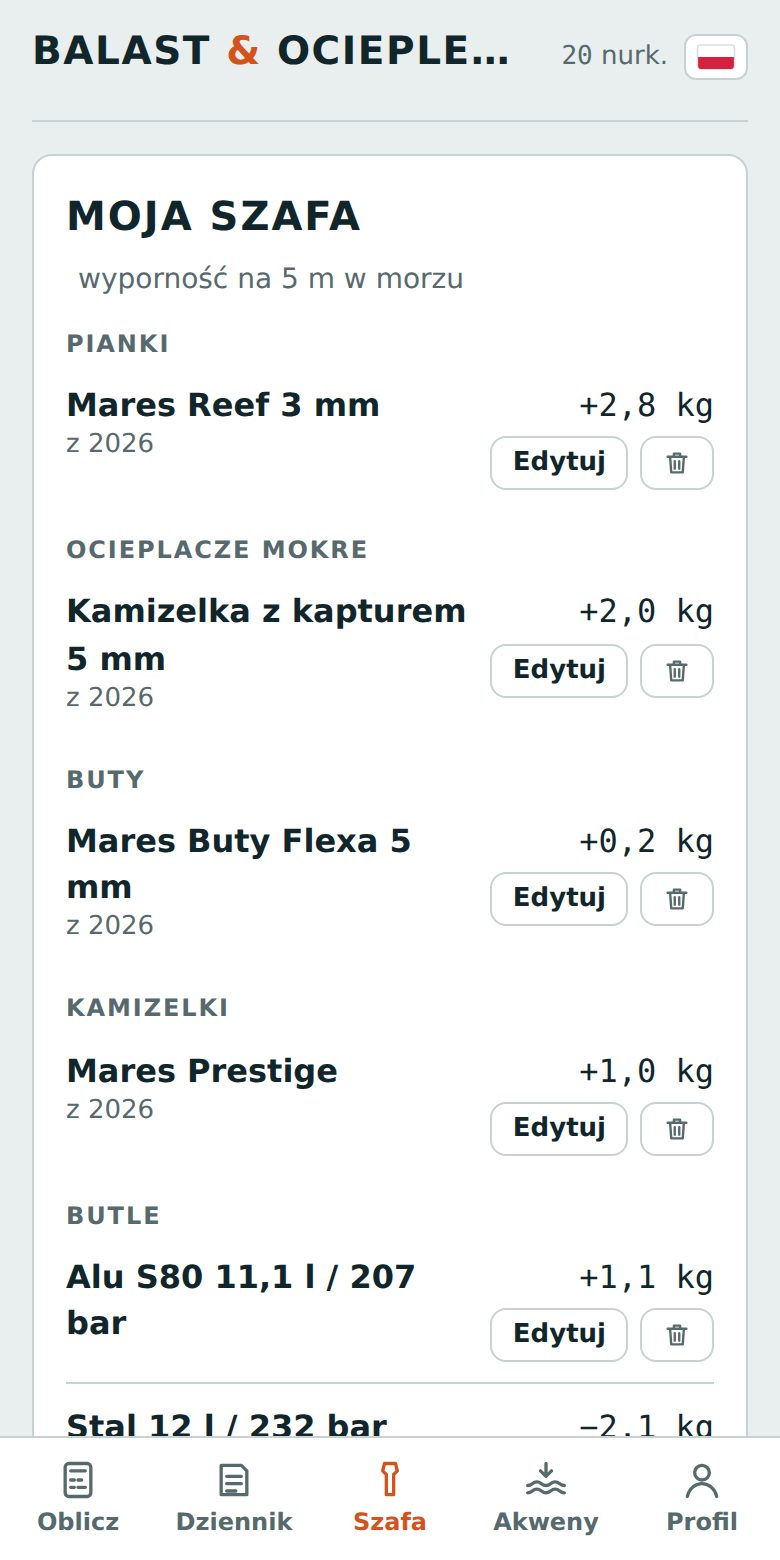
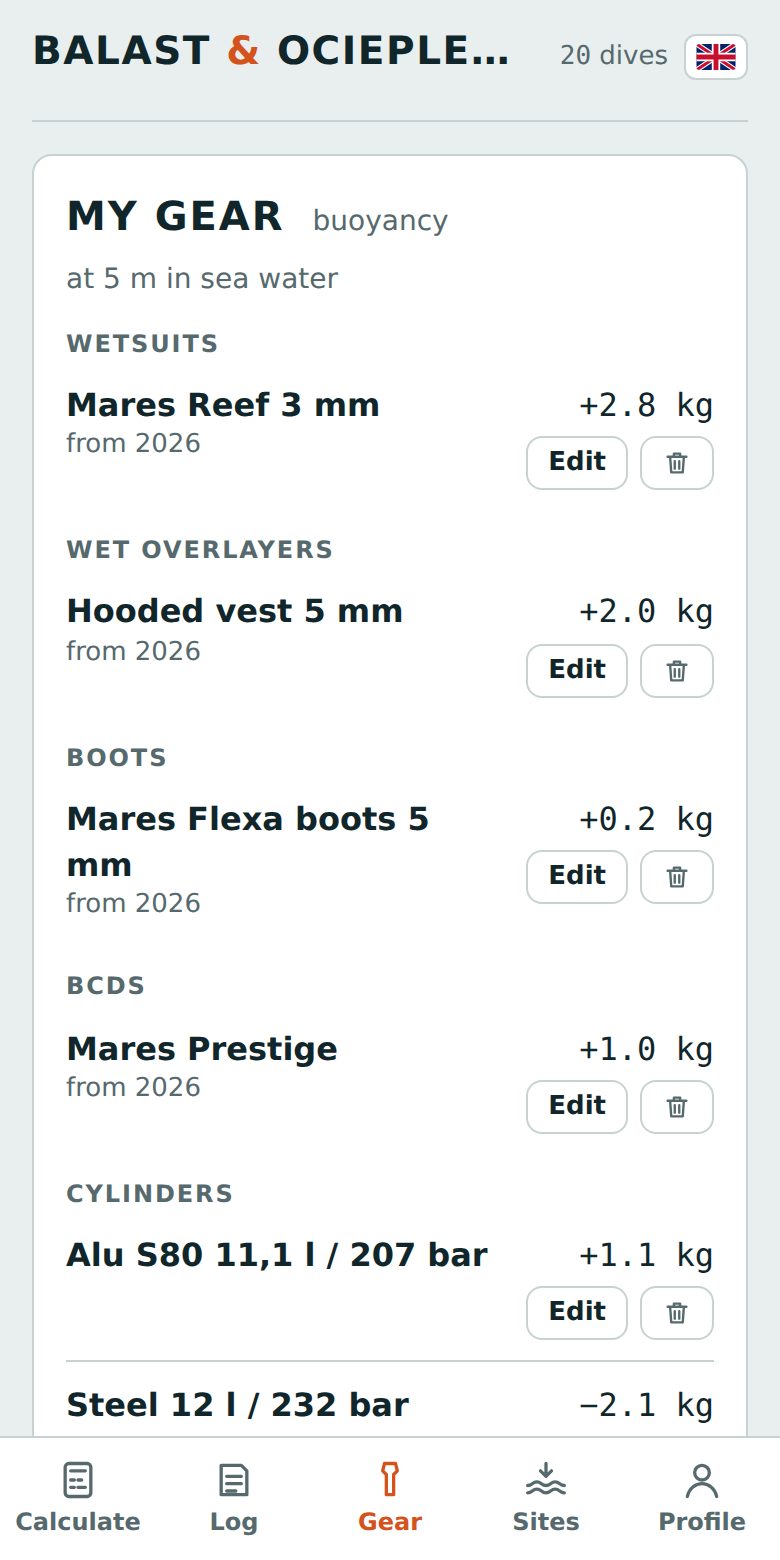
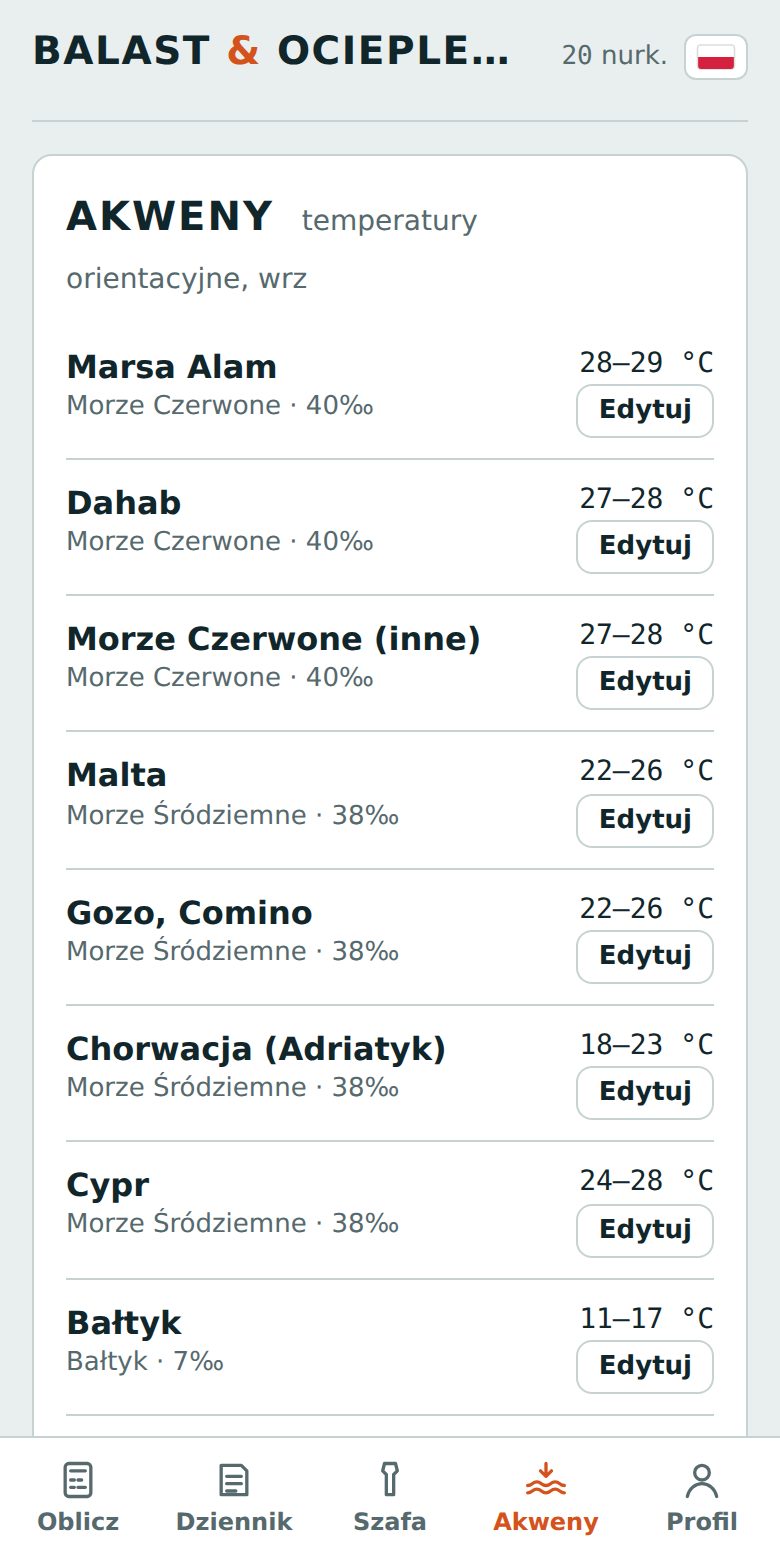
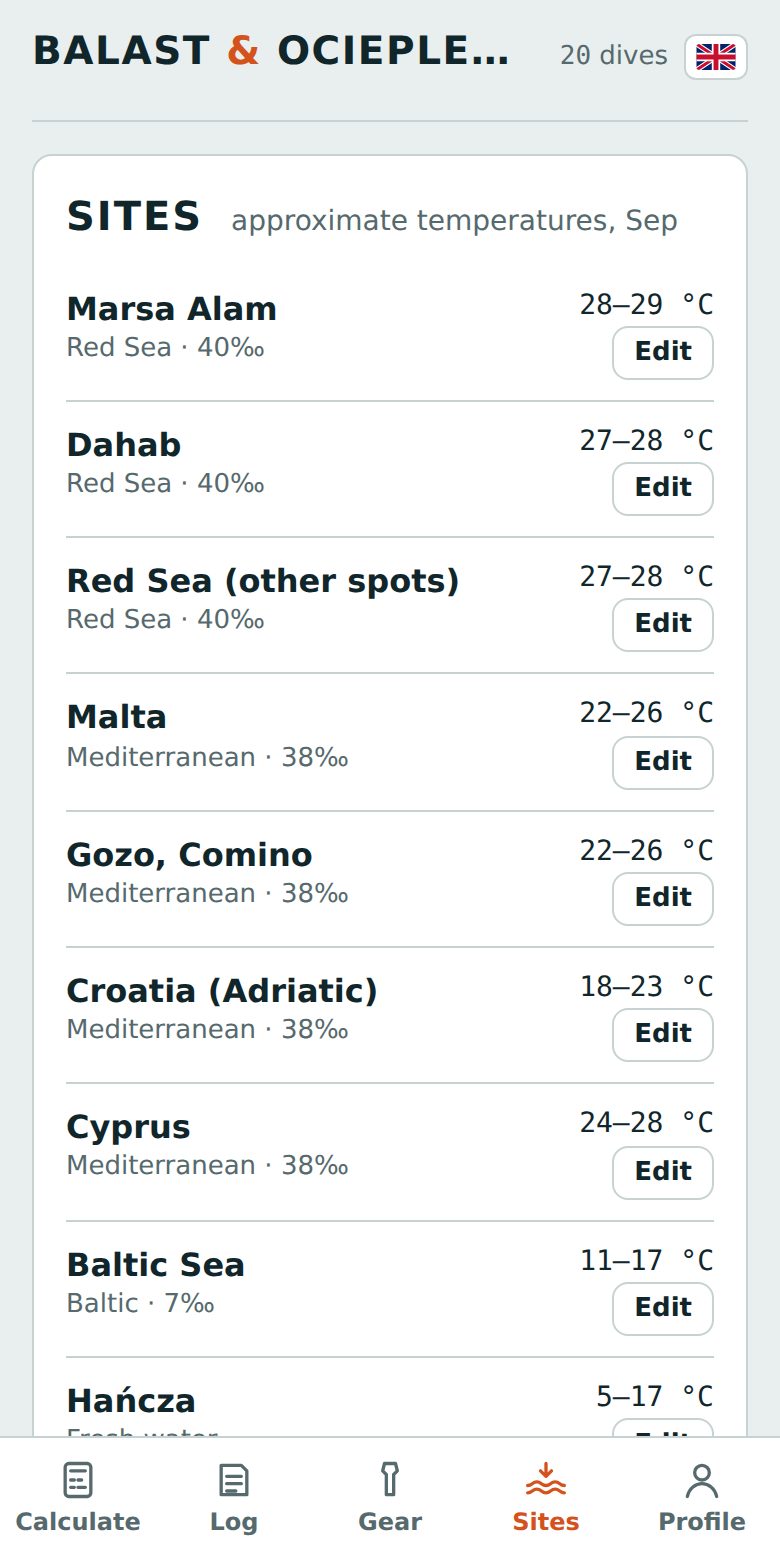
Akweny z temperaturami na każdy miesiącDive areas with temperatures for every monthMorze Czerwone, Malta, Chorwacja, Cypr, Bałtyk, polskie jeziora i kamieniołomy — każdy z gęstością wody i temperaturą powierzchni i dna. Najbliższy akwen po lokalizacji, gdy się zgodzisz.Red Sea, Malta, Croatia, Cyprus, the Baltic, Polish lakes and quarries — each with its water density and surface and bottom temperature. The nearest area from your location, if you allow it.
O₂
Nitroks, dziennik, import z komputeraNitrox, logbook, dive computer importMOD i najlepsza mieszanka wg tabel, dziennik nurkowań, wczytanie nurkowania z pliku komputera, kopia zapasowa do pliku, kilka profili nurków na jednym telefonie.MOD and best mix per the tables, a dive log, importing a dive from a computer file, backup to a file, several diver profiles on one phone.
171pozycji sprzętucatalogue items
13kategoriicategories
16akwenówdive areas
85nurkowisk na mapiemapped dive sites
Ołów i ocieplenie na jednym paskuLead and warmth in one bar
Najlżejsze wystarczające zestawyThe lightest kits that will do
Szafa: sprzęt z katalogu albo własnyGear: from the catalogue or your own
Akweny: gęstość i temperaturyAreas: density and temperatures
Aplikacja 2App 2Planer nurkowaniaDive Planner
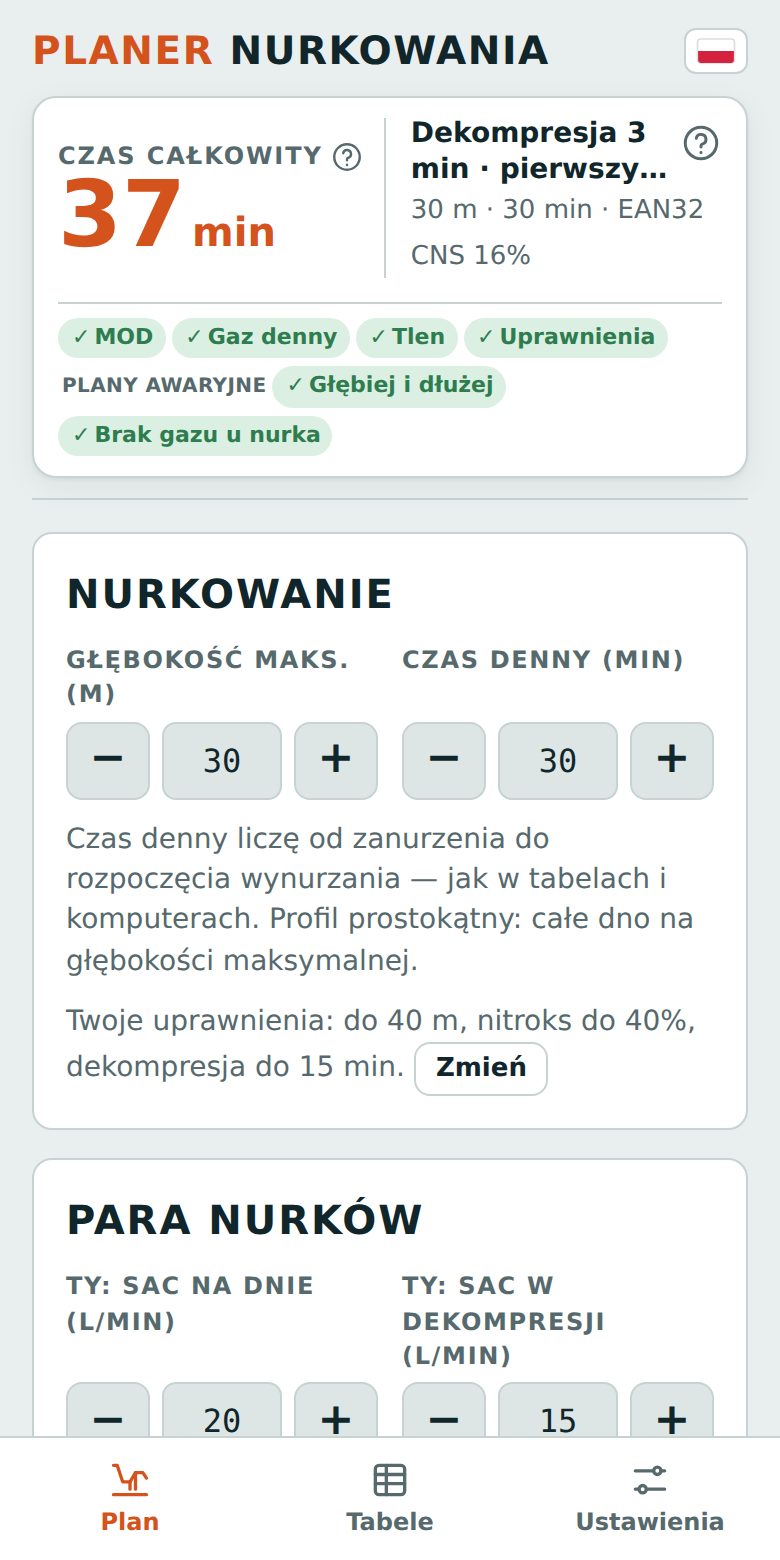
Plan pojedynczego nurkowania — i poprzedniego tego dnia — policzony tak, jak liczy komputer nurkowy, ale przed wejściem do wody i ze wszystkim, co trzeba sprawdzić na odprawie.
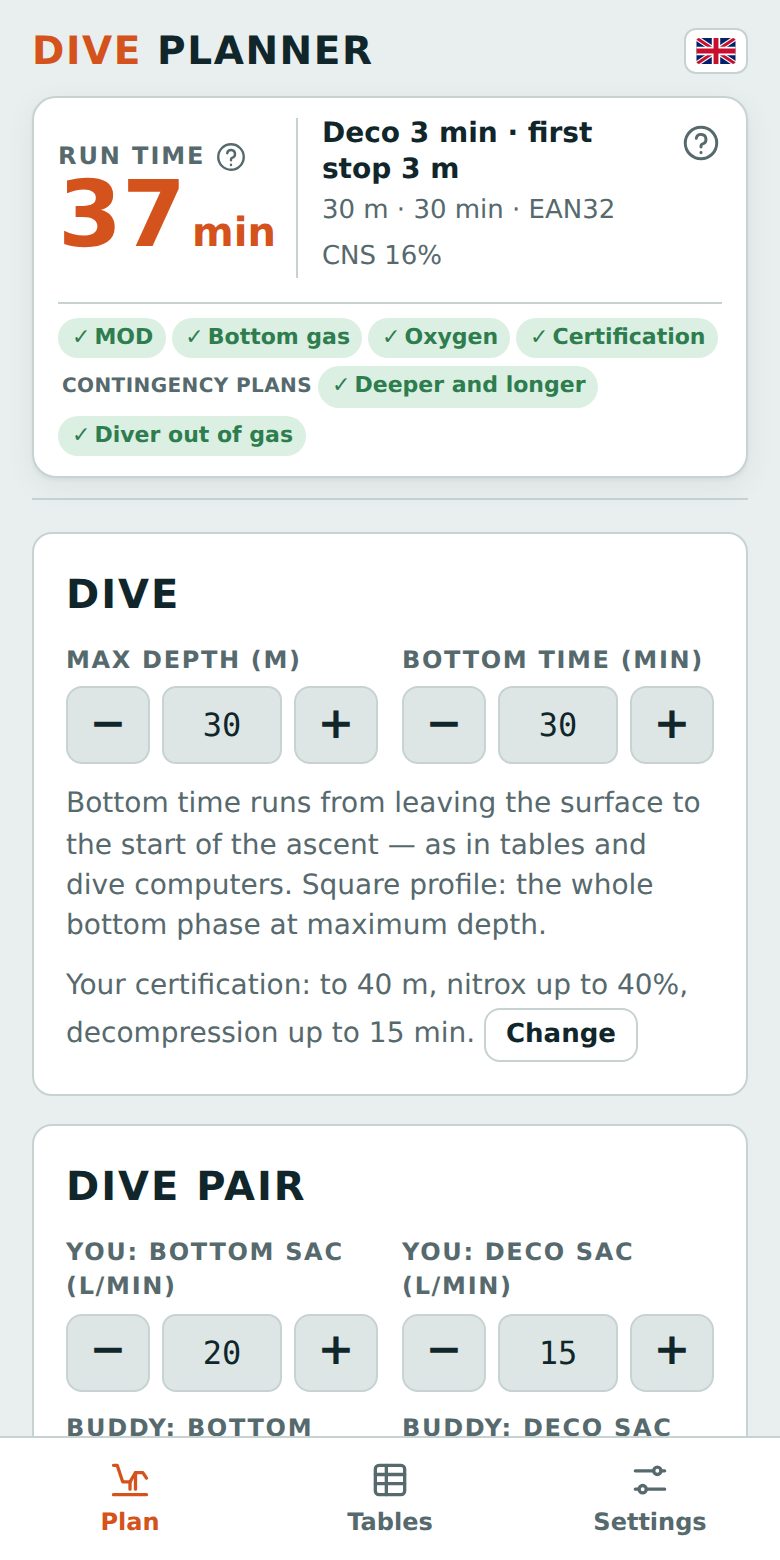
A plan for a single dive — and the one before it that day — computed the way a dive computer does it, but before you get in, with everything you need to check at the briefing.
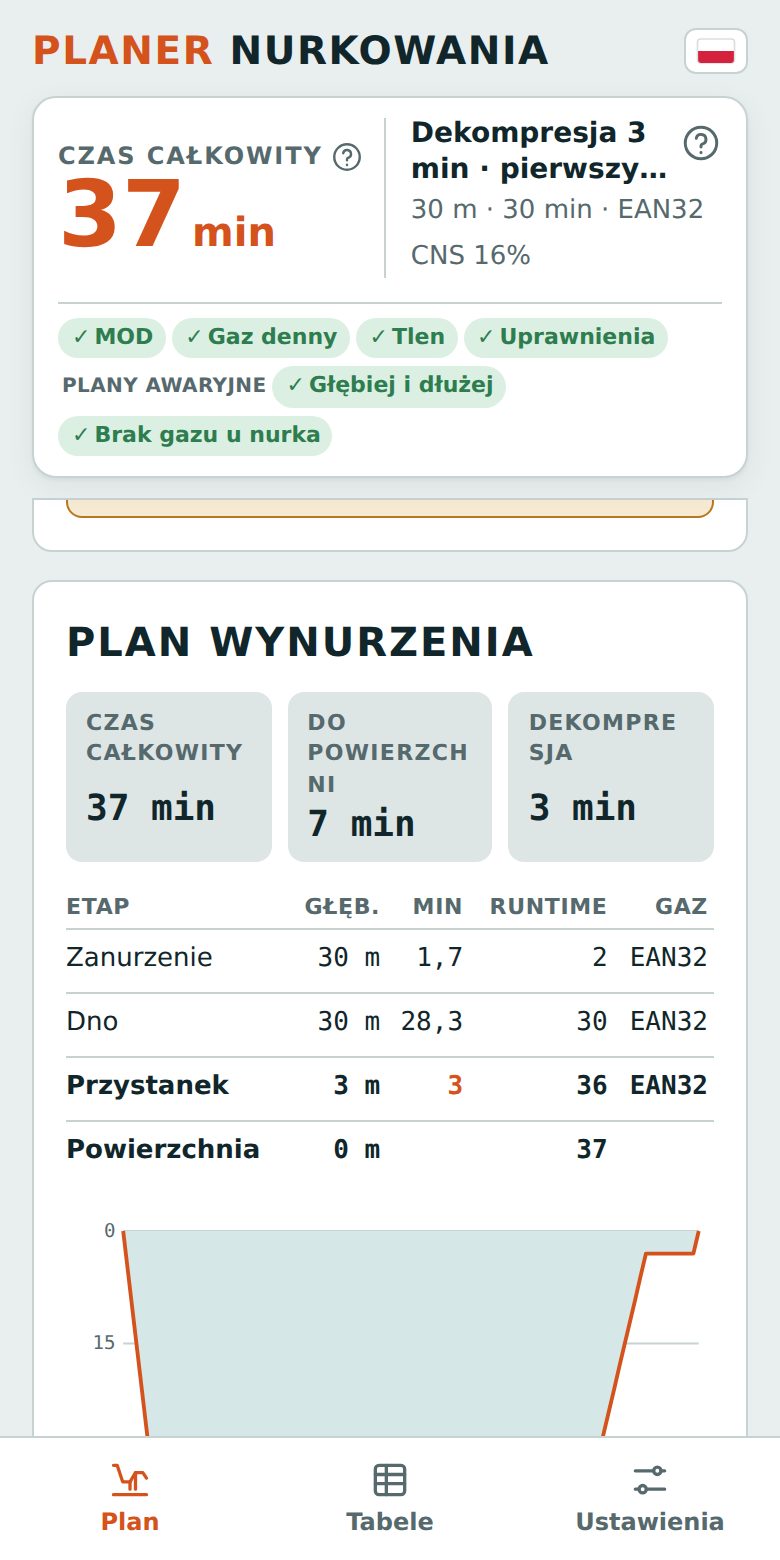
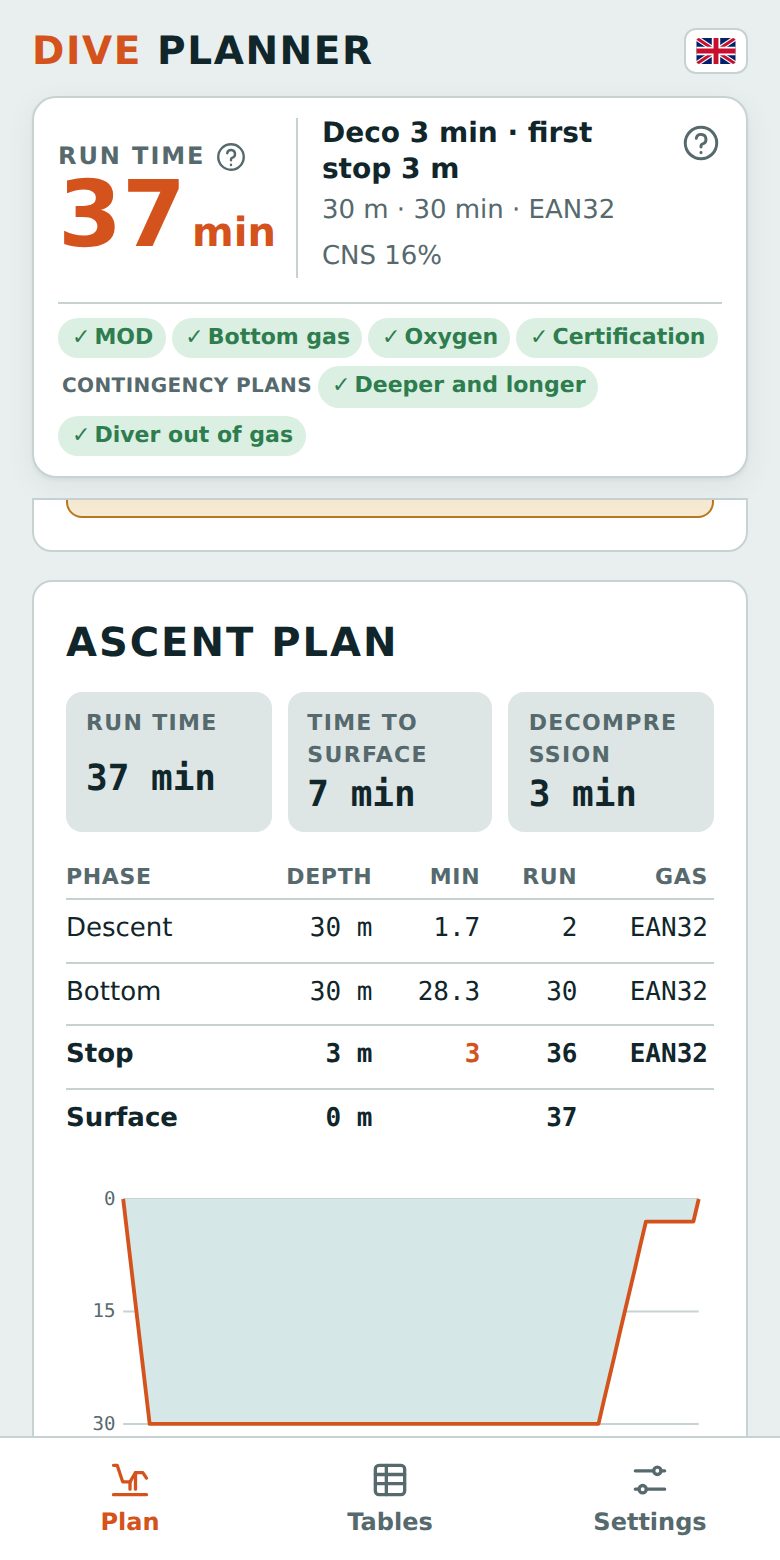
Dekompresja i tabela wynurzeniaDecompression and the ascent tableBühlmann ZHL-16C z gradient factors: przystanki co 3 m, czas całkowity, profil na wykresie. Limity bezdekompresyjne (NDL) i przystanek bezpieczeństwa.Bühlmann ZHL-16C with gradient factors: stops every 3 m, run time, the profile on a chart. No-decompression limits (NDL) and the safety stop.
GF
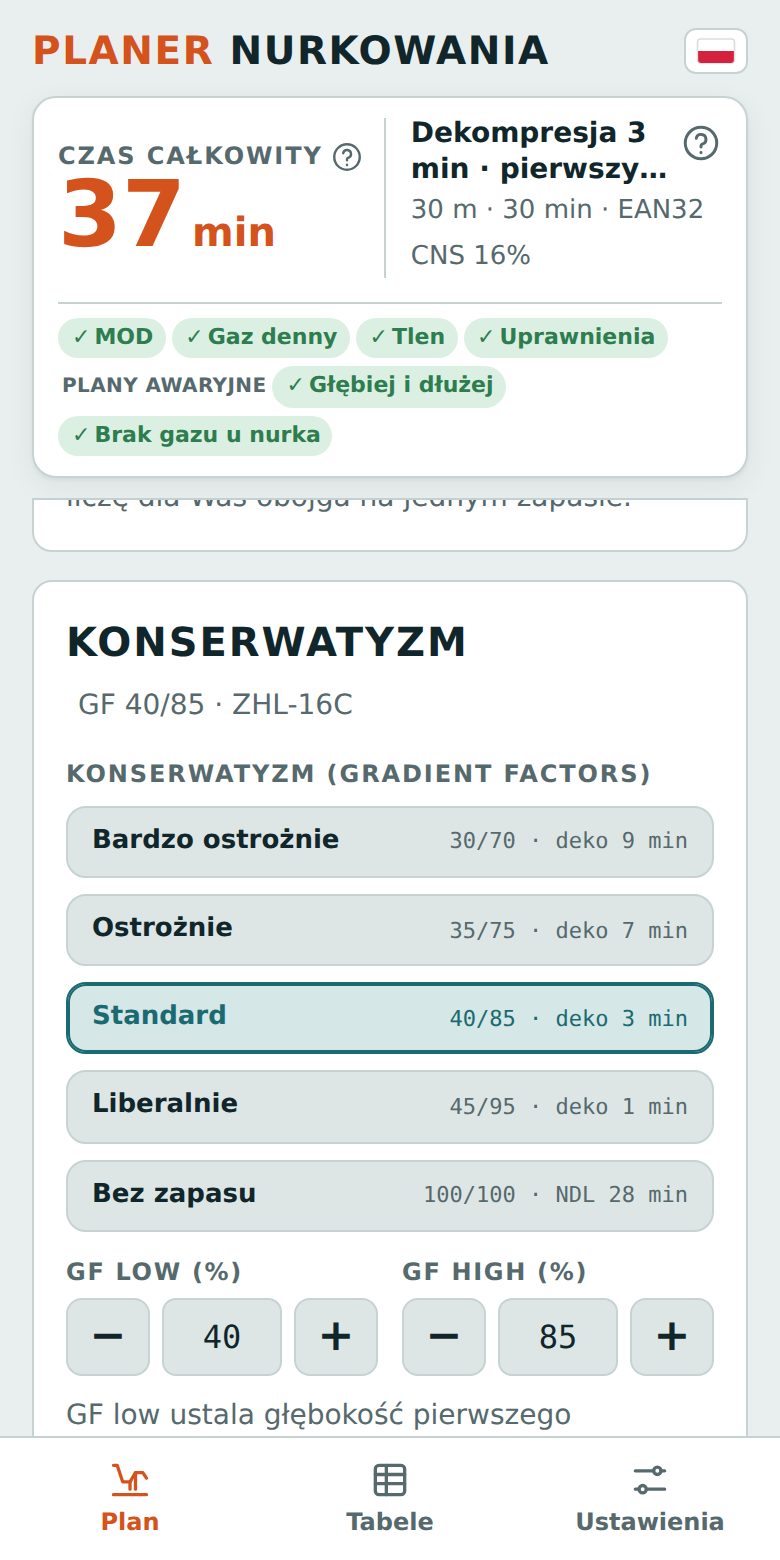
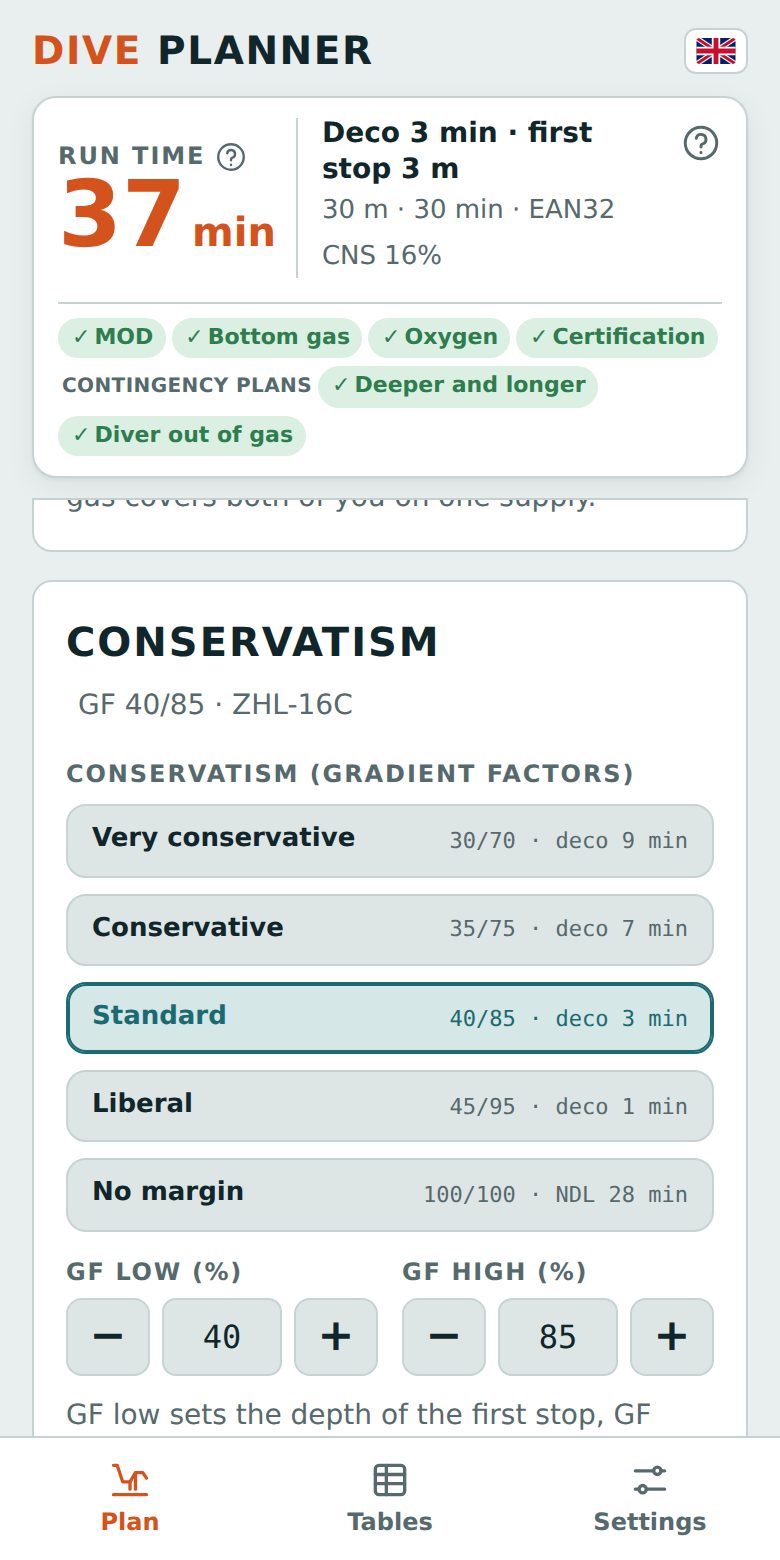
Konserwatyzm, który rozumieszConservatism you can seePięć ustawień od „bardzo ostrożnie” do „bez zapasu” z podglądem, ile dekompresji każde da w Twoim planie — albo własne GF low/high.Five settings from "very cautious" to "no margin", each showing how much deco it gives in your plan — or your own GF low/high.
bar
Gaz dla pary nurkówGas for a buddy pairOsobne SAC Twoje i partnera, zużycie na dnie i w dekompresji, minimum gazu (rock bottom), reguła ⅓ dla gazu deko (nitroks do 40%).Separate SAC for you and your buddy, consumption on the bottom and on deco, minimum gas (rock bottom), the rule of thirds for deco gas (nitrox up to 40%).
O₂
Tlen i narkozaOxygen and narcosispO₂, MOD, CNS%, OTU i EAD. Najlepsza mieszanka dla głębokości i najbliższa standardowa.pO₂, MOD, CNS%, OTU and EAD. The best mix for the depth and the nearest standard one.
!
Plany awaryjne w paskuContingencies at a glanceGłębiej i dłużej, utrata gazu deko, partner bez gazu — każdy z oceną „wystarczy / nie wystarczy”. Plan w granicach Twoich uprawnień i czas do lotu samolotem.Deeper and longer, lost deco gas, buddy out of gas — each marked "enough / not enough". A plan within your certification and the time before you can fly.
Statusy planu i tabela wynurzeniaPlan status and the ascent table
Konserwatyzm z podglądem skutkówConservatism with its effect shown
Nurkowanie i para nurkówThe dive and the buddy pair
Tabele NDL i MODNDL and MOD tables
Bez czarnej skrzynkiNo black box
Jak to liczy
How it works
Obie aplikacje liczą z opublikowanych modeli, a każdy wzór i stała są sprawdzone testami na konkretnych liczbach. Tu jest skrót — pełny opis jest w samych aplikacjach, pod znakami zapytania.
Both apps compute from published models, and every formula and constant is checked by tests against specific numbers. Here is the short version — the full one lives in the apps, behind the question marks.
Bühlmann ZHL-16C
Bühlmann ZHL-16C
Ciało to 16 „tkanek” (przedziałów), które nasycają się azotem w różnym tempie — połowiczne czasy od 5 do 635 minut. Szybkie tkanki decydują przy głębokich krótkich nurkowaniach, wolne — przy długich płytkich. Współczynniki a i b to wariant C, ten sam, którego używa większość komputerów nurkowych.
The body is modelled as 16 "tissues" (compartments) that take up nitrogen at different rates — half-times from 5 to 635 minutes. Fast tissues control deep short dives, slow ones control long shallow dives. The a and b coefficients are variant C, the one most dive computers use.
P(t) = P₀ + (P_gaz − P₀)·(1 − 2^(−t/T½))
Na stałej głębokości tkanka zbliża się do ciśnienia gazu wykładniczo (Haldane); przy zanurzaniu i wynurzaniu ciśnienie zmienia się liniowo (równanie Schreinera).
At constant depth a tissue approaches the gas pressure exponentially (Haldane); on descent and ascent the pressure changes linearly (the Schreiner equation).
Ciśnienie na powierzchni zależy od wysokości nad morzem, ciśnienie wody od jej gęstości (morze 1,025, Bałtyk 1,005, słodka 1,000). Para wodna w płucach: 0,0627 bar.
Surface pressure depends on altitude, water pressure on its density (sea 1.025, Baltic 1.005, fresh 1.000). Water vapour in the lungs: 0.0627 bar.
Gradient factors
Gradient factors
Czysty Bühlmann pozwala tkankom dojść do granicy (wartości M). Gradient factors Erika Bakera zabierają część tego zapasu: GF low ustala, jak głęboko jest pierwszy przystanek, GF high — ile przesycenia wolno mieć przy wyjściu na powierzchnię. Pomiędzy granica zmienia się liniowo.
Pure Bühlmann lets the tissues reach the limit (the M-value). Erik Baker's gradient factors take away part of that margin: GF low sets how deep the first stop is, GF high how much supersaturation is allowed when you surface. In between the limit changes linearly.
Dopuszczone przesycenie (% wartości M) na kolejnych przystankach przy GF 40/85: pierwszy przystanek na 21 m, wyjście na powierzchnię przy 85%.Allowed supersaturation (% of the M-value) at successive stops with GF 40/85: first stop at 21 m, surfacing at 85%.
Ustawienia i ich skutek
Settings and what they do
Domyślnie 40/85 — typowe „średnie” ustawienie komputerów. Kontrola: 30 m przez 25 minut na powietrzu.
Default 40/85 — a typical "medium" computer setting. Check: 30 m for 25 minutes on air.
Ustawienie
Setting
GF
Deko
Deco
Bardzo ostrożnie
Very cautious
30/70
17 min
Ostrożnie
Cautious
35/75
13 min
Standard
Standard
40/85
8 min
Liberalnie
Liberal
45/95
5 min
Bez zapasu
No margin
100/100
3 min
„Bez zapasu” to czysty Bühlmann — planer ostrzega, że GF high powyżej 95 prawie nie zostawia marginesu.
"No margin" is pure Bühlmann — the planner warns that GF high above 95 leaves almost no margin.
Limity bezdekompresyjne
No-decompression limits
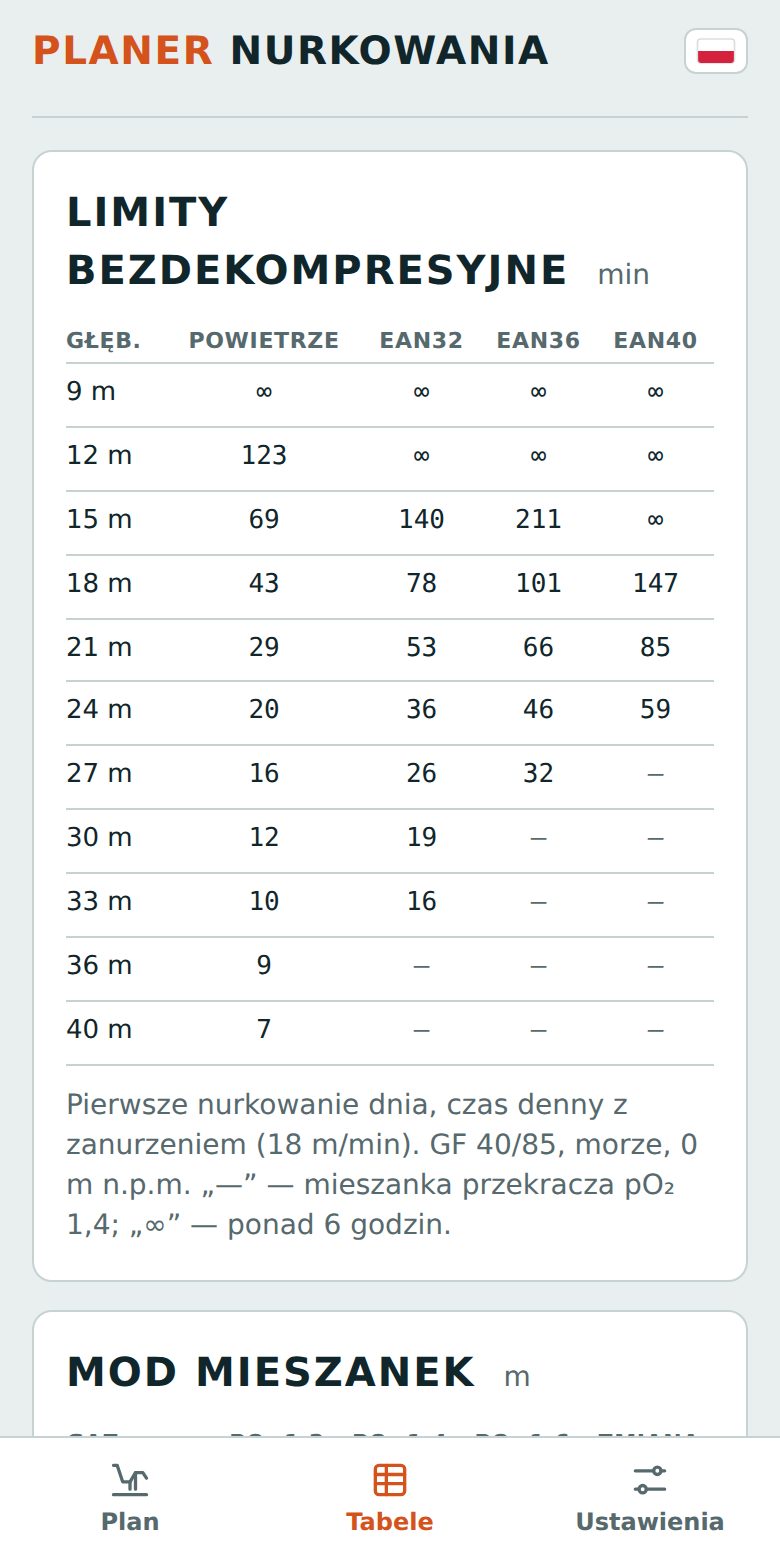
NDL to najdłuższy czas denny w pełnych minutach, po którym można wyjść na powierzchnię bez przystanków. Na powietrzu, w morzu, zanurzanie 18 m/min:
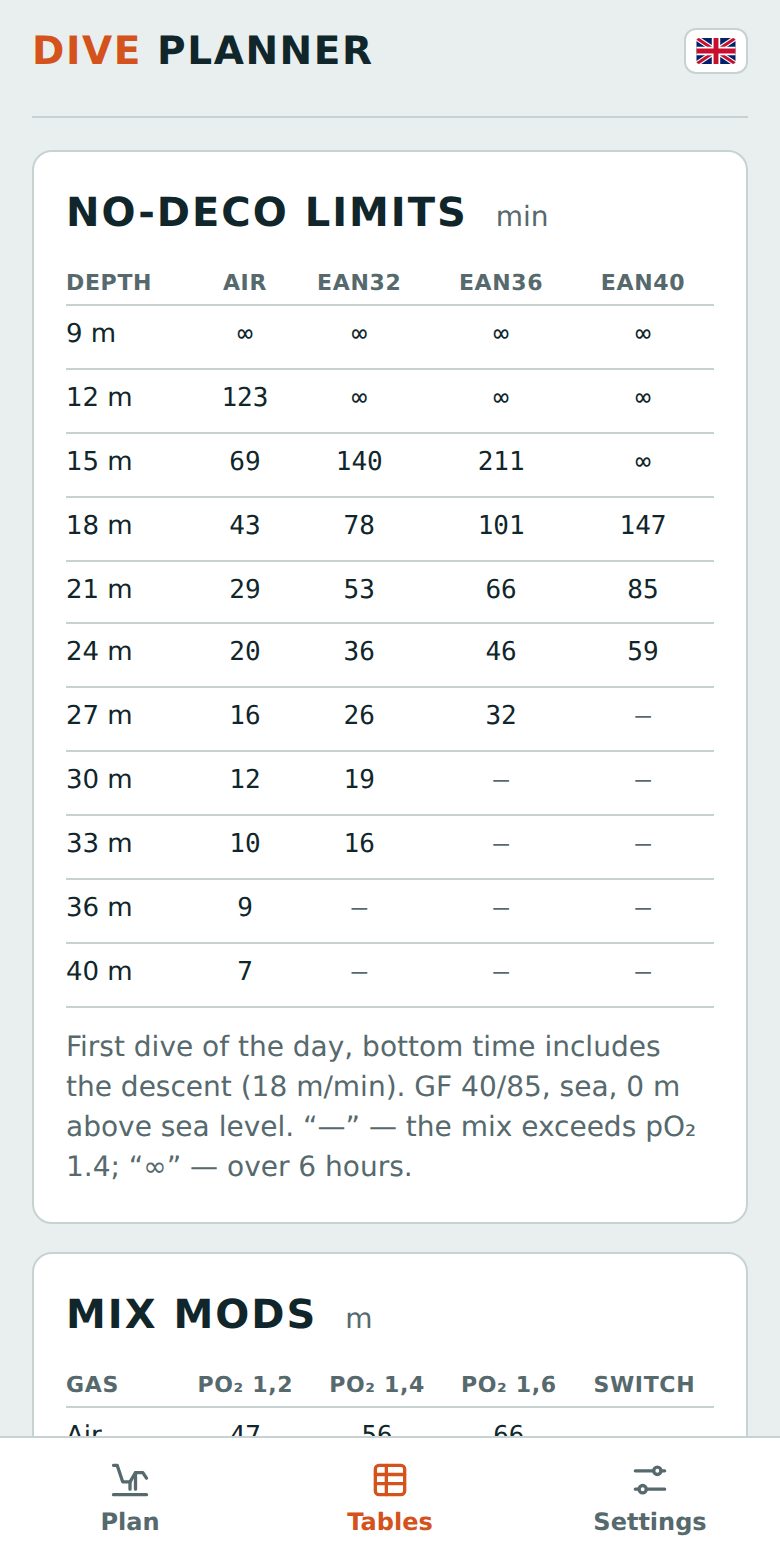
The NDL is the longest bottom time, in whole minutes, after which you can surface without stops. On air, in the sea, descending at 18 m/min:
Głębokość
Depth
GF 40/85
GF 100/100
12 m
123 min
179 min
18 m
43 min
59 min
30 m
12 min
17 min
40 m
7 min
9 min
Czas denny liczony od zanurzenia do początku wynurzania, profil prostokątny — całe dno na głębokości maksymalnej, jak w tabelach.
Bottom time counts from leaving the surface to the start of the ascent, square profile — the whole bottom at maximum depth, as in the tables.
Wynurzenie i gazy deko
Ascent and deco gases
Wynurzanie 9 m/min (opcja 10), przystanki co 3 m, ostatni na 3 albo 6 m, czasy w pełnych minutach.
Bez dekompresji, od 10 m — przystanek bezpieczeństwa 3 min na 5 m.
Dekompresja rekreacyjna (przy uprawnieniach Deep i EANx): łącznie do 15 min przystanków; gaz dekompresyjny — nitroks do 40% O₂, zmiana na najgłębszym przystanku, gdzie pO₂ ≤ 1,6 (EAN40 na 30 m).
Nurkowanie powtórzeniowe: poprzednie nurkowanie i przerwa na powierzchni wchodzą do tkanek; CNS spada o połowę co 90 min.
Ascent at 9 m/min (option 10), stops every 3 m, last stop at 3 or 6 m, times in whole minutes.
No-deco dives from 10 m get a 3-minute safety stop at 5 m.
Recreational decompression (with Deep and EANx certification): up to 15 min of stops in total; deco gas — nitrox up to 40% O₂, switched at the deepest stop where pO₂ ≤ 1.6 (EAN40 at 30 m).
Repetitive dives: the previous dive and the surface interval are carried in the tissues; CNS halves every 90 min.
Tlen i narkoza
Oxygen and narcosis
pO₂ i MOD liczone jak w tabelach: 10 m = 1 bar, MOD w dół do pełnego metra. W słodkiej wodzie i na wysokości to zawyża pO₂, więc błąd idzie w bezpieczną stronę.
pO₂ and MOD are computed as in the tables: 10 m = 1 bar, MOD rounded down to a whole metre. In fresh water and at altitude this overstates pO₂, so the error is on the safe side.
MOD = ⌊(pO₂ / FO₂ − 1) · 10⌋
EAN32, pO₂ 1,4 → 33 m
OTU = t · ((pO₂ − 0,5) / 0,5)^0,83
EAD = (D + 10) · FN₂ / 0,79 − 10
Limity pO₂: dno 1,4, dekompresja 1,6. CNS% z limitów NOAA (ostrzeżenie powyżej 80%, błąd powyżej 100%), OTU ostrzega powyżej 300. EAD powyżej 30 m — uwaga na narkozę.
pO₂ limits: bottom 1.4, decompression 1.6. CNS% from the NOAA limits (warning above 80%, error above 100%), OTU warns above 300. EAD beyond 30 m — watch for narcosis.
Minimum gazu (rock bottom): ile trzeba mieć na dnie, żeby oboje wynurzyli się na jednej butli — minuta na opanowanie problemu, oddech w stresie ×1,5, do pierwszej zmiany gazu albo do powierzchni z przystankami, w górę do 10 bar, nie mniej niż rezerwa 50 bar. Gaz deko: reguła ⅓. Gaz jest „OK” tylko wtedy, gdy wystarcza obojgu.
Minimum gas (rock bottom): what you must still have on the bottom for both of you to ascend on one cylinder — one minute to sort the problem out, stressed breathing ×1.5, up to the first gas switch or to the surface with stops, rounded up to 10 bar, never below the 50-bar reserve. Deco gas: the rule of thirds. Gas is "OK" only when it is enough for both of you.
Plany awaryjne i uprawnienia
Contingencies and certification
Głębiej i dłużej: ten sam plan +3 m i +3 min.
Utrata gazu deko: wynurzenie na samym gazie dennym i czy go wystarczy.
Partner bez gazu pod koniec dna: oboje wracają na zapasie dawcy — liczy się gorszy przypadek.
Uprawnienia: plan głębszy albo z dłuższą dekompresją, niż obejmują Twoje kursy, jest blokowany — planer pokazuje, co ustawić.
Lot samolotem (DAN): 12 h, 18 h po powtórzeniowym, 24 h po dekompresyjnym.
Deeper and longer: the same plan +3 m and +3 min.
Lost deco gas: the ascent on bottom gas alone, and whether there is enough.
Buddy out of gas at the end of the bottom: both ascend on the donor's gas — the worse case counts.
Certification: a plan deeper, or with longer deco, than your courses cover is blocked — the planner shows what to change.
Flying (DAN): 12 h, 18 h after repetitive dives, 24 h after deco dives.
Obieg otwarty, powietrze i nitroks — bez trimiksu i rebreatherów. Poniżej 55 m planer mówi wprost, że potrzebny jest hel. Plan to szacunek z modelu: nie zastępuje szkolenia ani komputera nurkowego. Nurkuj w granicach uprawnień, z planem awaryjnym.
Open circuit, air and nitrox — no trimix, no rebreathers. Below 55 m the planner says plainly that you need helium. A plan is a model estimate: it does not replace training or a dive computer. Dive within your certification, with a contingency plan.
Bilans wyporności na 5 m
A buoyancy balance at 5 m
Punkt kontrolny jest zawsze ten sam: 5 m, koniec nurkowania, rezerwa w butli, pusta kamizelka, pół oddechu. Każdy element sprzętu i ciało dają swoją wyporność w kilogramach, a ołów wyrównuje sumę. Wynik w wodzie przeliczamy na masę suchego ołowiu i zaokrąglamy w górę do 0,5 kg.
The check point is always the same: 5 m, end of the dive, reserve in the cylinder, empty BCD, half a breath. The body and every piece of gear contribute their buoyancy in kilograms, and the lead balances the sum. The in-water result is converted to the mass of dry lead and rounded up to 0.5 kg.
↑Ciało: % tłuszczu z BMI (Deurenberg, z poprawką na budowę), gęstość (Siri), powietrze w płucachBody: fat % from BMI (Deurenberg, adjusted for build), density (Siri), air in the lungszależy od Ciebiedepends on you
↑Neopren: powierzchnia ciała × pokrycie × grubość, ściskany głębokością, słabszy z wiekiem piankiNeoprene: body surface × coverage × thickness, compressed by depth, weaker as the suit agesc(d) = 0,6·(1 − 1/(1 + d/10))
↑Suchy skafander i ocieplacz — ocieplacz to gaz, który zajmuje objętośćDrysuit and undersuit — the undersuit is gas that takes up volume
↕Butla: wyporność pustej + gaz, który w niej został na rezerwieCylinder: empty buoyancy + the gas still in it at reservevol × bar × 0,00123
↕Kamizelka albo skrzydło z płytą, płetwy, automat, drobneBCD or wing and plate, fins, regulator, small items
↓Ołów = suma w wodzie ÷ (1 − ρ_wody / 11,34), w górę do 0,5 kgLead = in-water sum ÷ (1 − ρ_water / 11.34), up to 0.5 kg
Zasolenie wody
Water salinity
Wyporności w katalogu są podane dla morza (1,025). W innej wodzie ta sama rzecz wypiera tyle samo litrów, ale inaczej przelicza się to na kilogramy — dlatego gęstość akwenu wchodzi do wyporności całego sprzętu, nie tylko ciała i butli.
Buoyancy in the catalogue is given for the sea (1.025). In other water the same item displaces the same litres, but that converts to kilograms differently — so the site's density feeds the buoyancy of all the gear, not just the body and cylinder.
Woda
Water
ρ
Ołów*
Lead*
Kamieniołom, jezioro
Quarry, lake
1,000
3,5 kg
Bałtyk (≈7‰)
Baltic (≈7‰)
1,005
4,0 kg
Morze Czerwone (≈40‰)
Red Sea (≈40‰)
1,029
7,0 kg
* ten sam zestaw z suchym skafandrem i butlą stalową 12 l
* the same drysuit kit with a 12 l steel cylinder
Nauka z ocen
Learning from ratings
Fizyka daje wynik dla przeciętnego nurka. Twoje oceny po nurkowaniach go przesuwają: regresja grzbietowa (bayesowska) ze wspólną poprawką dla Ciebie i osobną dla każdej sztuki sprzętu. Nowsze nurkowania ważą więcej, a poziom doświadczenia ustala, jak bardzo model ufa fizyce na starcie.
Physics gives the answer for an average diver. Your ratings after dives move it: a (Bayesian) ridge regression with one correction for you and one for each piece of gear. Newer dives weigh more, and your experience level sets how much the model trusts physics at first.
Wynik ma przedział 80% — widać, jak pewna jest liczba. Im więcej ocen, tym węższy.
The result comes with an 80% range so you can see how sure the number is. More ratings, narrower range.
Komfort pianki wynika z grubości równoważnej (krój, półsucha, kaptur, ściśnięcie głębokością): 3 mm → 22 °C, 5 mm → 17 °C, 7 mm → 12 °C. Suchy — z ocieplacza. Twoja tolerancja zimna i oceny „zimno / OK / za ciepło” przesuwają granicę pod Ciebie.
Wetsuit comfort comes from equivalent thickness (cut, semi-dry, hood, compression with depth): 3 mm → 22 °C, 5 mm → 17 °C, 7 mm → 12 °C. Drysuits — from the undersuit. Your cold tolerance and "cold / OK / too warm" ratings move the limit towards you.
Temperatury akwenów
Dive area temperatures
Każdy akwen ma temperaturę powierzchni i dna na każdy miesiąc — z pomiarów satelitarnych, relacji baz i nurków oraz z własnych nurkowań; szacunki są w dokumentacji opisane jako szacunki. Temperaturę dna możesz poprawić w planie, a import z komputera wpisuje zmierzoną.
Every area has a surface and a bottom temperature for each month — from satellite data, reports from dive bases and divers, and our own dives; estimates are documented as estimates. You can correct the bottom temperature in the plan, and a computer import fills in the measured one.
Nitroks w Balaście
Nitrox in Ballast
MOD i najlepsza mieszanka dla głębokości z planu — wg tabel 10 m/bar, w dół do pełnego metra, najwyżej 40% O₂: 18 m → EAN40, 30 m → EAN35, 40 m → EAN28. Z przypomnieniem o uprawnieniach i analizie mieszanki.
MOD and the best mix for the planned depth — per the 10 m/bar tables, rounded down to a whole metre, at most 40% O₂: 18 m → EAN40, 30 m → EAN35, 40 m → EAN28. With a reminder about certification and analysing the mix.
Wynik to punkt startowy, nie pewność. Przy nowej konfiguracji zawsze zrób kontrolę pływalności na 5 m z rezerwą w butli i pustą kamizelką.
The result is a starting point, not a certainty. With a new configuration always do a buoyancy check at 5 m with a reserve in the cylinder and an empty BCD.
Bez sklepu z aplikacjamiNo app store needed
Dodaj do ekranu telefonu
Add it to your home screen
To aplikacje webowe (PWA): dodane do ekranu otwierają się jednym tapnięciem jak zwykła aplikacja, działają bez internetu i same się aktualizują. Zajmują ułamek miejsca aplikacji ze sklepu.
These are web apps (PWAs): once on your home screen they open with one tap like any other app, work offline and update themselves. They take a fraction of the space of a store app.
Otwórz link w SafariOpen the link in SafariTapnij przycisk wyżej albo zeskanuj kod. W Instagramie czy Messengerze wybierz najpierw „Otwórz w Safari”.Tap the button above or scan the code. In Instagram or Messenger choose "Open in Safari" first.
Tapnij „Udostępnij”Tap "Share"Kwadrat ze strzałką w górę — na dolnym pasku albo obok adresu.The square with an arrow pointing up — in the bottom bar or next to the address.
„Do ekranu początkowego”"Add to Home Screen"Przewiń listę w dół, jeśli nie widać tej opcji od razu.Scroll the list down if you don't see it straight away.
„Dodaj” — gotowe"Add" — doneIkona jest na ekranie. Otwieraj aplikację z ikony, nie z Safari.The icon is on your home screen. Open the app from the icon, not from Safari.
Ważne na iPhonie: aplikacja z ekranu ma osobną pamięć niż Safari. Jeśli zacząłeś w przeglądarce, zapisz kopię zapasową (Profil → Kopia zapasowa) i wczytaj ją w aplikacji — ona sama też to podpowie.
Important on iPhone: the home-screen app has separate storage from Safari. If you started in the browser, save a backup (Profile → Backup) and load it in the app — it will remind you too.
Otwórz link w ChromeOpen the link in ChromeTapnij przycisk wyżej albo zeskanuj kod aparatem.Tap the button above or scan the code with your camera.
Menu ⋮The ⋮ menuTrzy kropki w prawym górnym rogu.Three dots in the top right corner.
„Zainstaluj aplikację”"Install app"Czasem nazywa się „Dodaj do ekranu głównego”. Aplikacja może też sama pokazać przycisk „Zainstaluj”.Sometimes called "Add to Home screen". The app may also show its own "Install" button.
Potwierdź — gotoweConfirm — doneIkona pojawi się na ekranie i w szufladzie aplikacji.The icon appears on your home screen and in the app drawer.
Samsung Internet: menu ≡ → „Dodaj stronę do” → „Ekran startowy”. W przeglądarce wbudowanej w Facebooka czy Instagrama najpierw „Otwórz w Chrome”.
Samsung Internet: menu ≡ → "Add page to" → "Home screen". In the browser built into Facebook or Instagram choose "Open in Chrome" first.
Dla centrów nurkowychFor dive centres
Obie aplikacje w barwach Twojego centrum
Both apps in your centre's colours
Kursant dostaje od Ciebie link, dodaje aplikację do ekranu — i od tej chwili przy każdym planowaniu nurkowania widzi Twoje logo, Twoją nazwę pod ikoną i Twoje aktualności. Ta sama aplikacja, te same modele i aktualizacje, tylko Twoja.
Your student gets a link from you, adds the app to their home screen — and from then on, every time they plan a dive, they see your logo, your name under the icon and your news. The same app, the same models and updates, only yours.
Logo, kolory, ikonaLogo, colours, iconLogo w nagłówku i na powitaniu, kolory marki w jasnym i ciemnym motywie. Na ekranie telefonu kursanta ikony Balastu i Planera w Twoich kolorach, z nazwą centrum — np. „Laguna Balast” i „Laguna Plan”.Your logo in the header and on the welcome screen, brand colours in light and dark themes. On the student's home screen, the Ballast and Planner icons in your colours with your name — e.g. “Laguna Balast” and “Laguna Plan”.
Panel aktualności w Balaście i PlanerzeNews panel in Ballast and the PlannerWyjazdy, kursy, promocje — grafika, zdanie i link na górze ekranu, tam gdzie nurek zagląda przed każdym nurkowaniem. Zmiany wprowadzasz sam w panelu (neutraldive.app/panel): logujesz się adresem e-mail centrum, a kursanci widzą nowość przy następnym otwarciu aplikacji. Z datą od–do, znikają same.Trips, courses, offers — an image, a sentence and a link at the top of the screen, where divers look before every dive. You make the changes yourself in the panel (neutraldive.app/panel): sign in with your centre's e-mail address, and students see the update the next time they open the app. With from–until dates; they expire by themselves.
Sprzęt z Twojej ofertyGear from your shopKatalog sprzętu w aplikacji dopasowany do tego, co masz w sprzedaży i w wypożyczalni — kursant liczy balast na sprzęcie, który u Ciebie kupi albo wypożyczy.The in-app gear catalogue matched to what you sell and rent — students work out their weighting on gear they will buy or rent from you.
Twoja woda na startYour water by defaultNowy nurek startuje od Twojego akwenu, a w profilu ma Twój telefon, e-mail i stronę. Własny adres: neutraldive.app/twoje-centrum.New divers start at your dive area, and their profile shows your phone, e-mail and website. Your own address: neutraldive.app/your-centre.
PrzykładyExamples
LogoLogoWgraj logoUpload logo
Podgląd · nic nie wysyłamyPreview · nothing is uploaded
Wgraj logo (PNG, SVG, JPG) — kolor dobierze się sam z logo, możesz go zmienić. Logo zostaje w Twojej przeglądarce; nic nie trafia na serwer.
Upload a logo (PNG, SVG, JPG) — the colour is picked from it automatically, and you can change it. The logo stays in your browser; nothing reaches a server.
za rok, za obie aplikacjeper year, for both apps≈ 15,75 EUR/mies. — 159 EUR taniej niż miesięcznie≈ 15.75 EUR/month — 159 EUR less than monthlyZamów wersję rocznieOrder yearly
W cenie
Included
Balast i Ocieplenie oraz Planer nurkowania w barwach centrum
Ikony aplikacji w barwach centrum, z jego nazwą na ekranie telefonu kursanta
Panel aktualności w Balaście i Planerze — zmiany wprowadzasz sam w panelu
Katalog sprzętu dopasowany do Twojej oferty
Domowy akwen i dane kontaktowe centrum
Wszystkie aktualizacje modeli i nowe funkcje
Nie przetwarzamy danych kursantów — zostają w ich telefonach
Ballast & Thermal and Dive Planner in your centre's colours
App icons in your colours, with your name on the student's home screen
News panel in Ballast and the Planner — you make the changes yourself in the panel
A gear catalogue matched to your shop
Your home dive area and contact details
All model updates and new features
We process no student data — it stays on their phones
Pytania
Questions
Czy to naprawdę za darmo?Is it really free?
Tak. Wersje podstawowe obu aplikacji są bezpłatne dla nurków, bez reklam i bez konta. Rozwój finansują centra nurkowe, które zamawiają wersję w swoich barwach.
Yes. The standard versions of both apps are free for divers, with no ads and no account. Development is funded by dive centres that order a version in their own colours.
Gdzie są moje dane?Where is my data?
Tylko w Twoim telefonie. Aplikacje nie mają konta ani analityki; lokalizacji nie zapisują ani nie wysyłają. Z sieci pobierają tylko listę aktualności — bez żadnych danych o Tobie. Dane przeniesiesz na inny telefon kopią zapasową do pliku.
Only on your phone. The apps have no account and no analytics; they don't store or send your location. The only thing they download is the news list — with no data about you. You move your data to another phone with a backup file.
Czy planer zastępuje komputer nurkowy?Does the planner replace a dive computer?
Nie. To narzędzie do planowania i nauki — pokazuje, co policzy komputer i co się stanie, gdy coś pójdzie nie tak. Pod wodą decyduje komputer, szkolenie i plan awaryjny.
No. It is a tool for planning and learning — it shows what your computer will compute and what happens when something goes wrong. Underwater, your computer, your training and your contingency plan decide.
Czy działa bez internetu?Does it work without internet?
Tak — po pierwszym otwarciu obie aplikacje działają offline. Aktualizacje pobierają się same, gdy telefon ma zasięg.
Yes — after the first launch both apps work offline. Updates download by themselves when the phone has signal.
Jak długo trwa przygotowanie wersji dla centrum?How long does a centre version take?
Wystarczy logo, kolory, domowy akwen i lista sprzętu z oferty. Aplikacja centrum dostaje własny adres, a kursanci instalują ją tak samo jak wersję podstawową.
All we need is your logo, colours, home dive area and the gear you sell. Your app gets its own address, and students install it just like the standard version.
 Neutral·Dive